

In our product description, we advertise, among other things, the inline measurement of entrainment. What's behind this term? It's worth taking another look at the basics of process engineering.
Separation Technology — The Basics
In principle, separation technology in the chemical industry is based on combining and separating liquid or gaseous material streams. The goal: to concentrate the valuable material, the so-called target component, in as pure a form as possible in one stream. This exploits the fact that the target component is particularly good at accumulating in one stream.
In a separation apparatus, streams of different phases are mixed together so that this accumulation can take place. At the outlet of the separation apparatus, the phases must be separated from each other again. In distillation, this is a liquid and a gaseous stream. In extraction, on the other hand, it's two immiscible liquid streams.
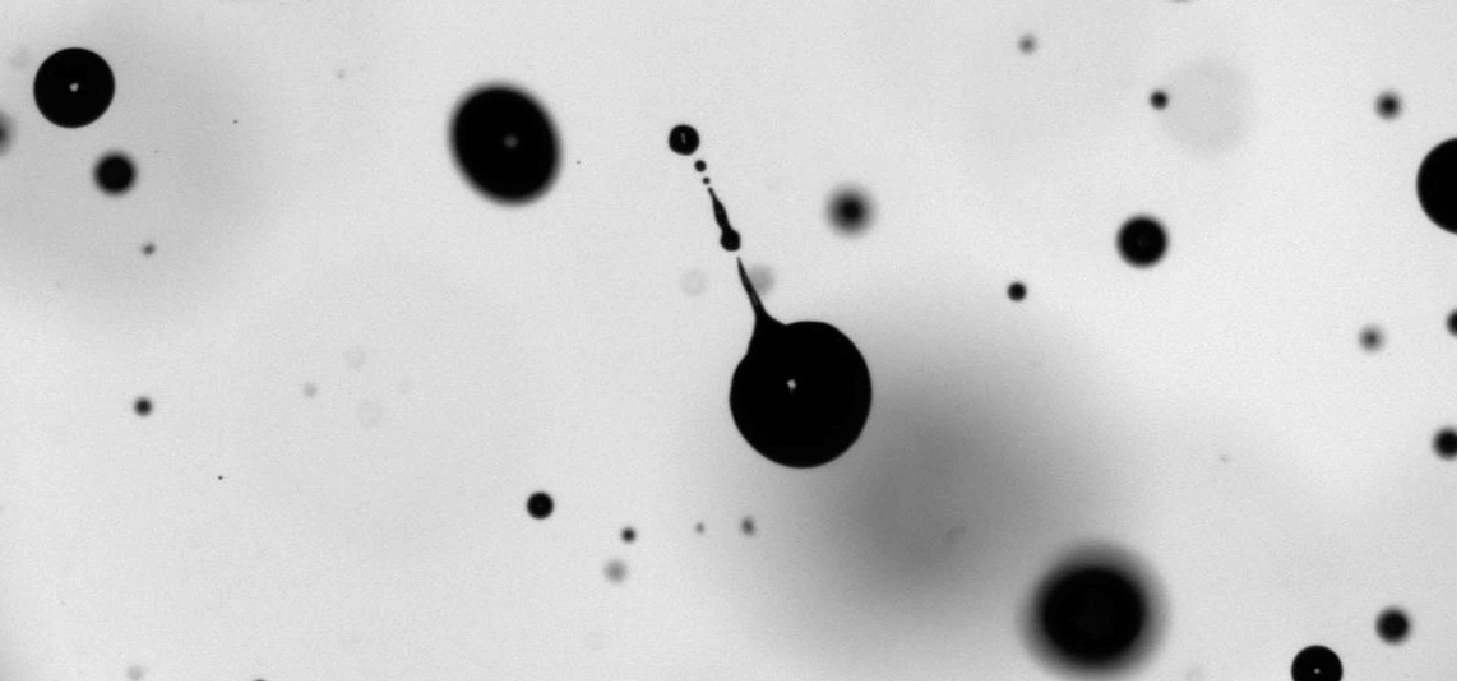
For a perfect separation of the phases, the apparatus would have to be infinitely large. However, this isn't possible. The compromise: the apparatus has a realistic size, and in return, a small portion of the foreign phase is carried along in the stream. This is what's known as entrainment or carryover. This can be gas bubbles or droplets.
So What's the Problem with Entrainment?
First of all, entrainment causes a loss of valuable material. The energy demand of a plant also increases when more entrainment occurs. And: downstream equipment such as pumps or compressors can be damaged by entrainment. To prevent this, so-called separators are installed at the outlets of the apparatus. But even a separator like this eventually reaches its limits and "breaks through" — meaning the entrainment can pass through unhindered.
Conclusion
Entrainment cannot be prevented and is factored into plant planning. However, if entrainment is stronger than calculated, performance losses in the plant and, in the worst case, damage to the equipment can be expected.
Real-time monitoring of entrainment in critical process steps is therefore highly recommended!
