

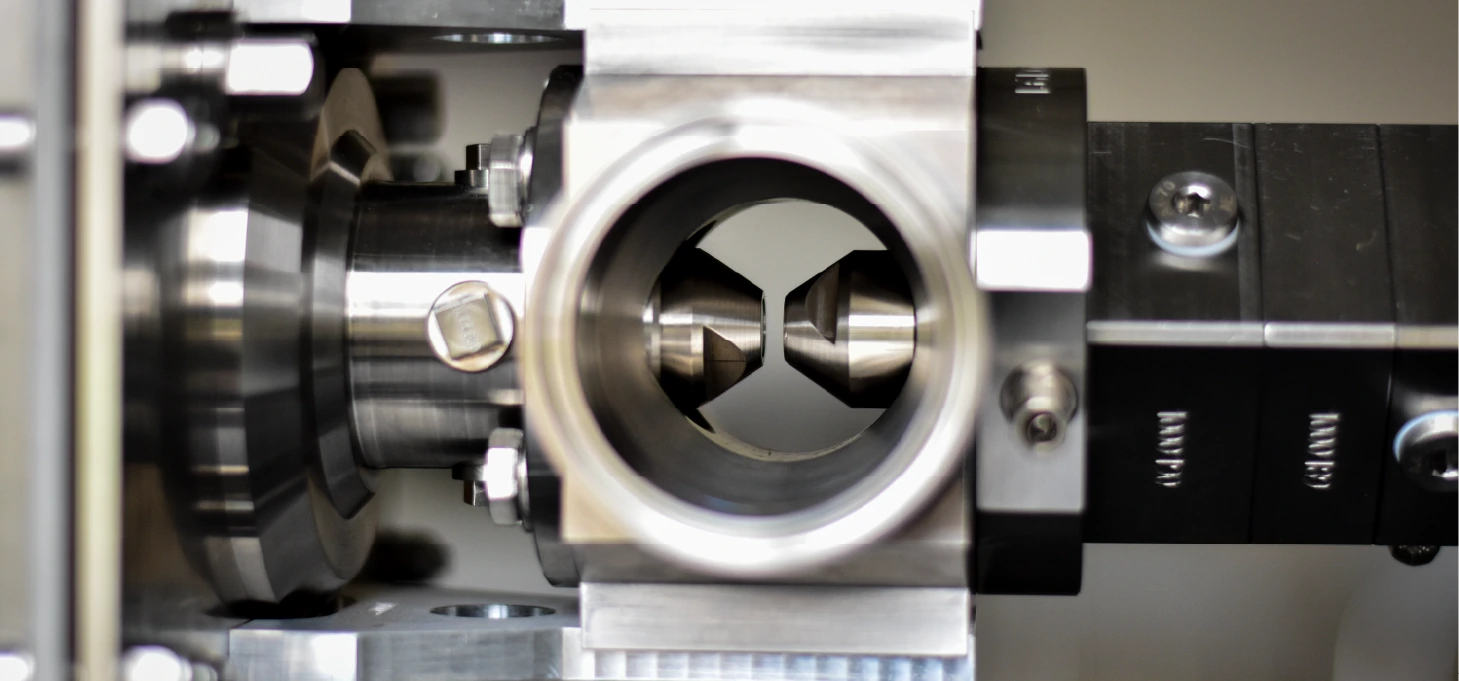
We advertise our sensors with the word inline — but what exactly does that mean for the application? Here's a brief excursion into process analytics.
To monitor production processes in the chemical and food industries, measurement data is collected at many points. This involves detecting physical or chemical properties of the process streams or recording the state of an individual apparatus. All these measured variables together represent the state of the process and are referred to as process analytical technology — PAT for short.
What Is PAT Needed For?
These measured variables are what make it possible to operate a complex chemical plant in the first place, since many parameters are not set manually but controlled from a control room. The operating team also relies on the measurement data for monitoring and optimizing the plant.
The 4 Types of Measurement Data Acquisition
Generally, a distinction is made between 4 types of measurement data acquisition:
OFFLINE
The classic: take a sample, send it to the lab, and receive results after some waiting time.
ATLINE
Essentially the same as offline, except that the sample analysis takes place on a device positioned near the plant. Advantage: waiting time is saved, and the result is available faster.
ONLINE
Bringing the measurement technology closer to the process to avoid manual sampling. Online measurement methods are usually implemented via a sample loop that draws process medium out of the apparatus, measures it, and returns it. This can already be considered a kind of real-time measurement. However, there's a risk that the sample loop will clog over time, distorting the measurement.
INLINE
The top discipline: the measuring device sits directly in the plant and measures right where the action happens. This means true real-time data — without distortion.
Why Isn't Everything Measured Inline?
Measurands that are easy to detect inline include, for example, temperature or mass flow. However, some measurands, such as concentration or particle size, are not so easy to determine inline. The reason: the measurements are very complex, the measuring instrument is sensitive, and it is not easy to integrate into harsh process conditions.
For this reason, particle size is currently still often measured offline. The consequence:
- No real-time data
- No way to counteract in the process when particle size is faulty
- No data for particles that cannot be sampled (droplets, bubbles)
And this unfortunately often results in:
- Unwanted plant downtime
- Disposal of failed products
- Trial-and-error troubleshooting in the process
That's Why: Measure Particle Sizes Inline!
Save real money and valuable time — we'll show you how.
