

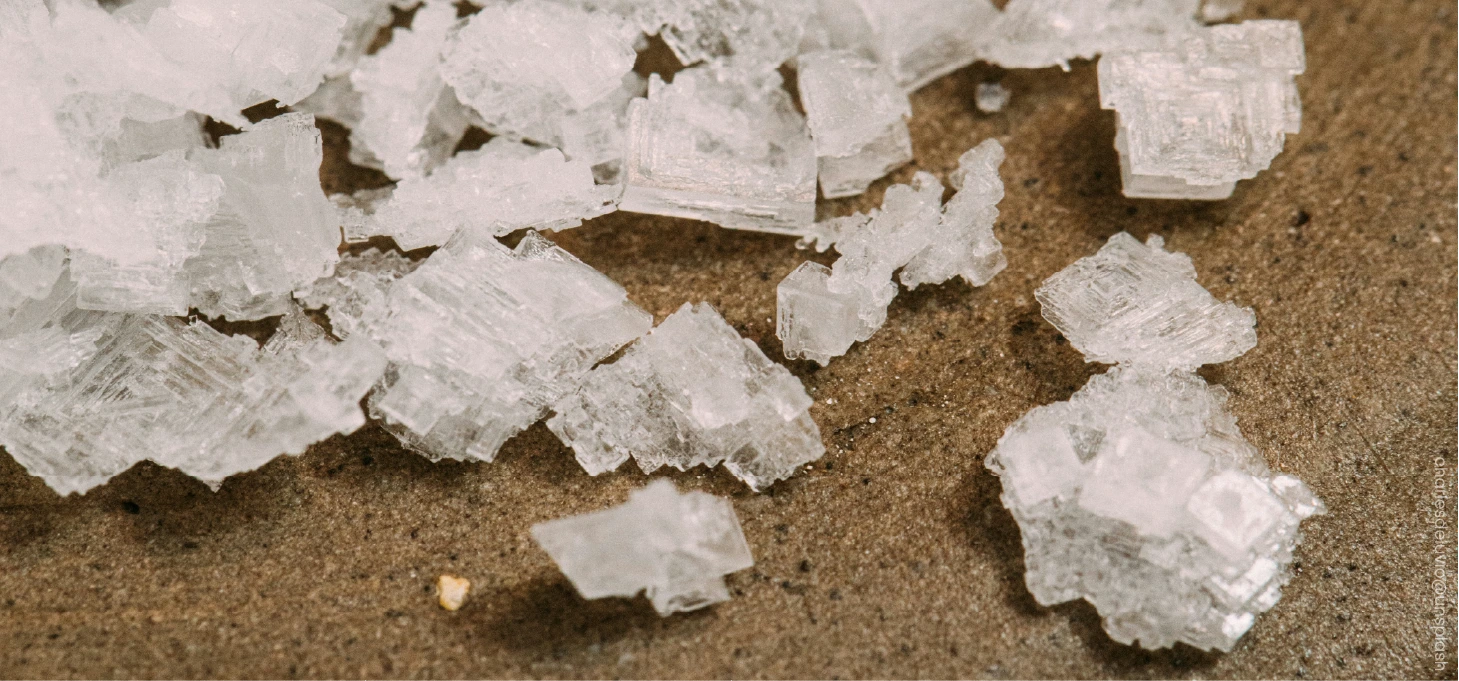
We've designed one of our sensors specifically for use in crystallizations. But why is real-time detection of particle size and shape so important in crystallization?
In crystallization, crystals form from a liquid solution through cooling or evaporation. This is used to obtain valuable substances, for example in pharmaceutical manufacturing or fertilizer production.
The resulting crystals have a regular structure. But which crystal shape ultimately leaves the apparatus — the so-called crystallizer — at the end of a crystallization is difficult to predict.
Factors Influencing the Final Crystal Shape
Many process conditions influence the final crystal shape:
- Depending on the solvent or the cooling rate, different crystal shapes can form.
- The more vigorously the apparatus is stirred, the more crystals collide with one another — crystal breakage occurs. The result: the crystals become smaller and rounder, and the crystal size distribution becomes broader.
- Crystals sticking together — the formation of so-called agglomerates — also changes the crystal shape.
- The crystallization must be carried out long enough to bind as many valuable molecules as possible in crystal form. But not too long, otherwise crystal breakage increases.
And the trickiest part: all these phenomena overlap in a crystallizer. Individually, they're well researched, but in combination they're rarely well understood.
Why Is the Final Particle Shape So Important?
The crystallization slurry that leaves the crystallizer is not yet the final product. Afterward, the slurry must be filtered, dried, and formulated into its final state (tablet, powder, fertilizer pellet). All these steps only work well if the crystal shape is right.
A few examples:
- The more uniform the crystals are, the better they dissolve and the better they can be utilized by the body.
- The compaction and compressibility of a crystal powder into tablet form is heavily dependent on the particle shape.
- Uniform, large crystals filter better than small ones.
- Good flow behavior is important during filling: round particles flow well, while needle-shaped crystals tend to clump.
To avoid unnecessarily disrupting the production process, particle shape and size at the crystallizer outlet are determined very precisely by sampling. If the parameters aren't right, the crystals are discarded or redissolved — an expensive, time-consuming, and not particularly resource-efficient process.
Why Not Counteract Inline?
So why not measure these parameters during crystallization and actively counteract them? That's exactly what we want to achieve with our technology!
- Less scrap
- Fewer process disruptions
- Higher product quality
