

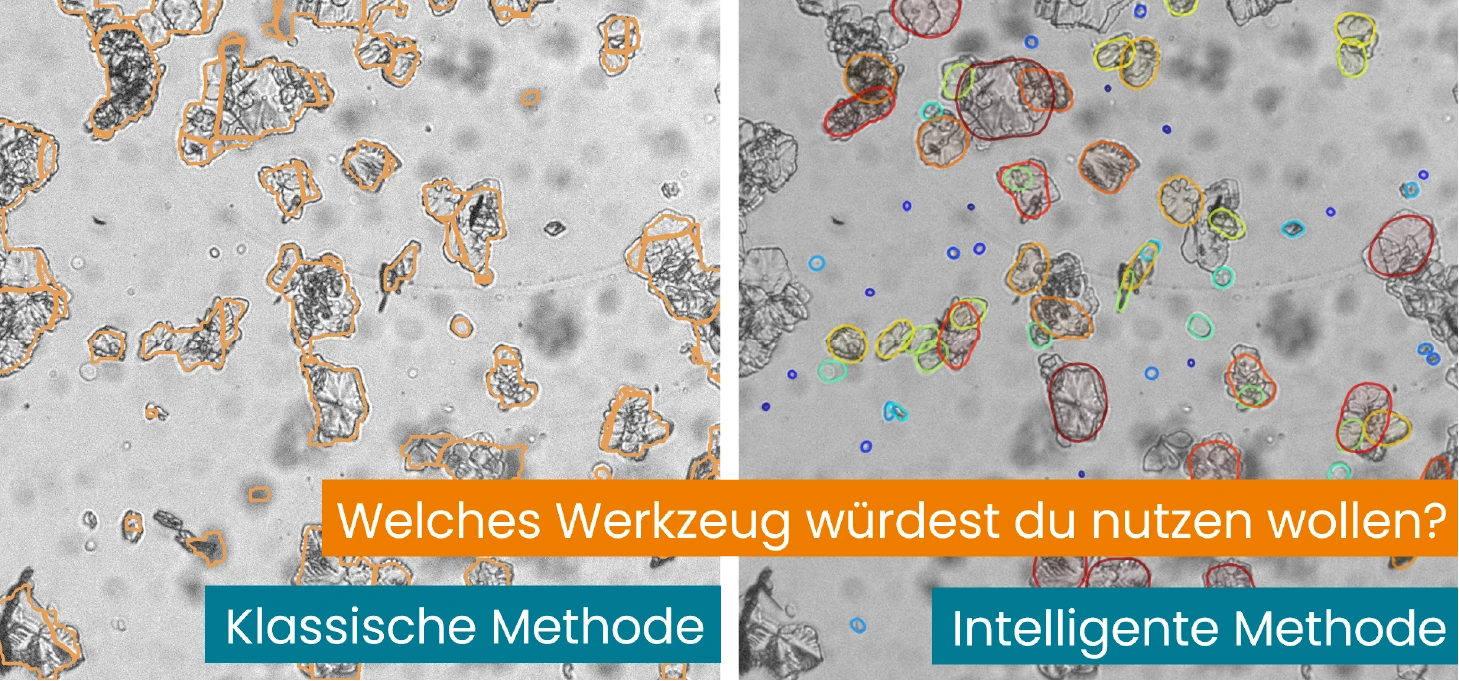
In many industries, particle analysis determines quality and process efficiency. Thousands of particle images are generated every day — but capturing them is only the beginning. The real challenge lies in the evaluation: how can reliable data on particle size and shape be obtained from them quickly, precisely, and reproducibly?
The Status Quo: Manual Evaluation
In many laboratories, particle images are still evaluated completely by hand today. An employee marks particle after particle on screen, measures diameters, and estimates shapes. This isn't just monotonous — it's a massive economic bottleneck.
The numbers speak for themselves: an experienced specialist often needs 30 to 60 minutes to precisely measure just 100 particles. Scaled up across a full test series, this creates costs and time losses that are barely sustainable in modern production. Regulatory requirements make the problem worse, since safety assessments require a minimum number of particle detections (> 1,000) for statistical significance. Objectivity also suffers, since results can vary from employee to employee.
First Automation: Classic Image Processing Methods
To replace manual work, rule-based algorithms have been developed over decades. These follow a fixed logic and use tools such as:
- Preprocessing: Background subtraction and various filtering methods reduce noise.
- Isolation: Objects are isolated from the background using thresholding or edge detection.
- Shape optimization: Morphological operations (such as erosion and dilation) smooth particle edges, while contour estimation mathematically describes the outer shape.
- Separation: More complex approaches such as the watershed transform, concave point segmentation, or superpixel segmentation attempt to isolate touching particles from one another.
The Solution of the Future: AI-Based Object Detection
This is where artificial intelligence (AI) comes in. Unlike rigid, pixel-based logic, a neural network learns from examples.
- Leveraging intelligence: The AI recognizes particles even at extremely high densities or heavy noise because it recognizes complex patterns. It can be taught particle characteristics.
- Time savings: The effort of initial training or calibrating the AI pays off quickly. While classic algorithms must be laboriously "tuned" manually for every new product, a well-trained AI flexibly adapts to new conditions.
- Optimizing training: Yes, AI needs data initially. But modern tools already use pretrained models that massively accelerate this process. The output is a fully automated analysis in real time.
Conclusion: Efficiency Through Intelligent Automation
The era of manual evaluation and unstable "makeshift solutions" with classic algorithms is coming to an end. For companies that truly want to understand particle processes and also implement inline technologies, AI is a prerequisite for scalability.
